
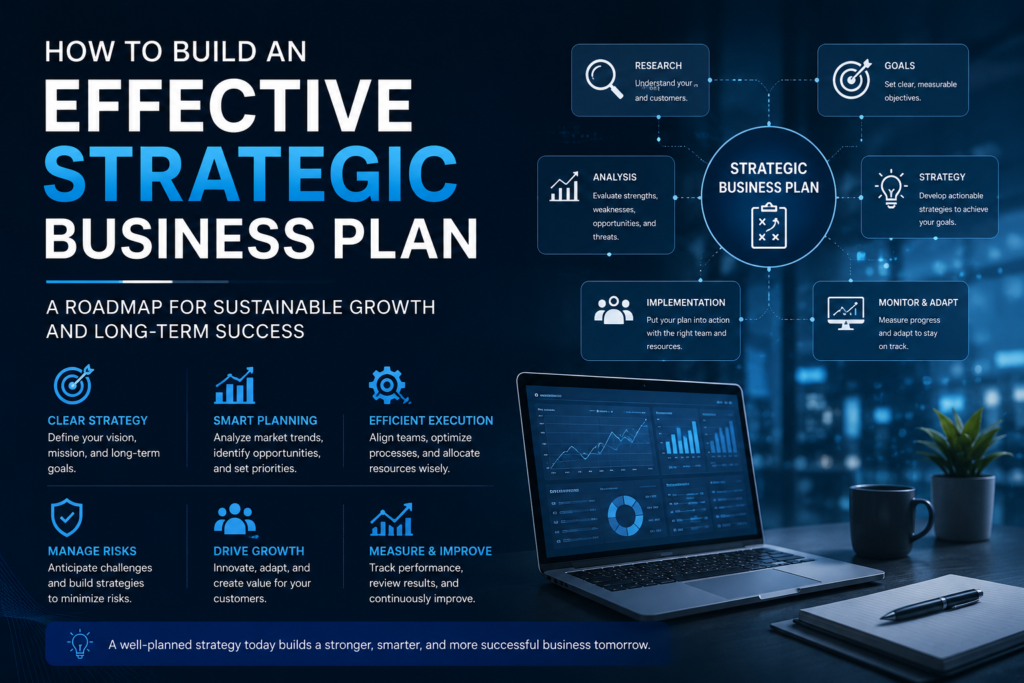
How to Build an Effective Strategic Business Plan for a Technology Company
A strategic business plan for a technology company provides a clear roadmap for achieving long-term growth in a rapidly changing digital environment. From SaaS platforms and software development companies to AI startups, IT service providers, and digital product businesses, technology companies must constantly adapt to new technologies, changing customer expectations, and increasing competition.
Unlike traditional businesses, technology companies often operate in markets where products, tools, and customer needs can change quickly. A technology that is competitive today may become outdated within a few years. Without a clear strategy, businesses can lose focus, invest in the wrong technologies, or spend valuable resources on opportunities that do not support their long-term objectives.
A well-developed strategic plan helps technology businesses make informed decisions about product development, technology investments, market expansion, hiring, customer acquisition, and financial growth. It creates alignment between business goals and technology capabilities while providing a structured approach to managing opportunities and risks.
Whether you are building a startup, scaling a SaaS platform, expanding an IT services business, or developing a digital product, strategic planning can provide the foundation for sustainable growth, innovation, scalability, and long-term competitiveness.
What Is a Strategic Business Plan for a Technology Company?
A strategic business plan for a technology company is a forward-looking roadmap that explains where the business wants to go and how it plans to achieve its long-term objectives, usually over a three- to five-year period.
Unlike operational planning, which focuses on daily activities and short-term tasks, strategic planning focuses on major decisions that influence the future direction of the business.
For technology companies, these decisions may involve:
- Product and software development
- Technology investments
- Artificial intelligence and automation
- Cloud infrastructure
- Cybersecurity
- Market expansion
- Customer acquisition and retention
- Team and talent development
- Revenue and profitability goals
- Research and innovation
A strong strategic plan connects the company’s vision, technology, products, people, customers, and financial objectives into one clear direction.
The goal is not simply to adopt the newest technology. Instead, businesses should identify technologies and opportunities that create measurable value for customers and support long-term business objectives.
Why Strategic Planning Matters for Technology Businesses
Technology markets move quickly. New software platforms, AI tools, cloud technologies, and digital business models can create new opportunities while also disrupting existing ones.
This makes strategic planning particularly important for technology companies.
A well-structured strategic business plan for a technology company can help leadership:
- Identify profitable growth opportunities
- Prioritize technology investments
- Allocate resources more effectively
- Improve product development
- Understand customer needs
- Respond to market changes
- Strengthen competitive positioning
- Manage business and technology risks
- Plan for sustainable expansion
Instead of reacting to every new technology trend, businesses can evaluate which opportunities align with their goals, capabilities, and target market.
Key Objectives of Strategic Planning in Technology
Strategic planning should translate a company’s long-term vision into measurable objectives. For technology businesses, several areas deserve particular attention.
1. Business Growth and Scalability
Technology companies often aim to scale quickly, but rapid growth without proper planning can create operational, financial, and technical challenges.
A strategic plan helps businesses determine how they will scale their products, infrastructure, workforce, customer base, and revenue.
For example, a growing SaaS business may need to plan for additional cloud capacity, customer support, cybersecurity resources, and software development teams as its user base increases.
2. Technology Investment
Technology companies constantly evaluate whether to invest in artificial intelligence, automation, cloud infrastructure, cybersecurity, data analytics, or new software platforms.
Strategic planning helps businesses evaluate investments based on:
- Business value
- Customer demand
- Expected return
- Scalability
- Security
- Implementation costs
- Long-term relevance
This approach prevents companies from investing in technology simply because it is popular or trending.
3. Product Development
A clear product strategy ensures that development resources are focused on features and solutions that customers actually need.
Businesses can use customer feedback, product analytics, market research, and competitor analysis to identify which features should receive priority.
This helps development teams focus on meaningful improvements rather than continuously adding features without a clear business purpose.
4. Customer Experience
Customer expectations continue to rise across digital markets. Users expect technology products to be fast, reliable, secure, intuitive, and easy to use.
A strategic plan should therefore consider:
- User experience
- Product usability
- Customer onboarding
- Technical support
- Personalization
- Customer feedback
- Retention
- Service reliability
Improving customer experience can increase satisfaction, strengthen retention, and create long-term business value.
5. Long-Term Profitability
Growth should be supported by a sustainable financial model.
Technology companies should consider revenue streams, pricing, customer acquisition costs, operating expenses, cloud infrastructure costs, employee expenses, development costs, and expected profitability.
The objective is to build a business that can grow efficiently rather than increasing expenses at the same rate as revenue.
Strategic vs. Operational Planning in Technology
Strategic and operational planning work together, but they serve different purposes.
| Aspect | Operational Planning | Strategic Planning |
|---|---|---|
| Time Horizon | Daily, weekly, monthly | 3–5 years |
| Primary Focus | Tasks, projects, resources | Growth, technology, markets |
| Decision Type | Tactical and execution-focused | Proactive and directional |
| Main Goal | Complete immediate objectives | Achieve long-term business goals |
| Typical Decisions | Sprint planning, support, deployments | Product expansion, investment, market entry |
Operational planning focuses on what the company needs to do today, while strategic planning determines where the company should be in the future.
For example:
- Developing a software feature is an operational activity, while deciding to launch a product in a new market is a strategic decision.
- Managing cloud resources is operational, while developing a long-term cloud infrastructure strategy is strategic.
- Hiring a developer for an immediate project is operational, while building a long-term engineering team is strategic.
Both planning levels should remain connected so that daily activities contribute to broader business objectives.
Key Factors That Influence Technology Business Strategy
Developing an effective strategy requires an understanding of both internal capabilities and external market conditions.
Rapid Technological Change
Artificial intelligence, cloud computing, automation, cybersecurity, data analytics, and other technologies continue to evolve.
Businesses should monitor these developments carefully, but they should not adopt every new technology without considering its actual business value.
The right technology strategy focuses on solutions that improve efficiency, solve customer problems, reduce costs, or create new revenue opportunities.
Increasing Competition
Technology markets can be highly competitive. A company may compete with established organizations, startups, open-source solutions, and emerging technologies.
A strong strategy should identify what makes the business different and why customers should choose its product or service over alternatives.
Changing Customer Expectations
Customers increasingly expect seamless digital experiences, fast service, reliable products, strong security, and responsive support.
Technology businesses should therefore include customer research, feedback, analytics, and market trends in their strategic decision-making.
Cybersecurity and Data Protection
Security is no longer only an IT responsibility. It is an important part of business strategy.
Technology companies should consider cybersecurity, data protection, access controls, infrastructure security, and applicable privacy requirements when planning long-term growth.
Building a Competitive Advantage in Technology
A sustainable competitive advantage allows a technology company to stand out in a crowded market.
Competitive advantage can come from:
- Innovative products
- Proprietary technology
- Strong user experience
- Technical expertise
- Faster development
- Competitive pricing
- Reliable customer support
- Data and analytics capabilities
- Strong brand reputation
- Specialized industry knowledge
For example, two software companies may provide similar functionality, but one may differentiate itself through better customer support, easier implementation, stronger security, or a simpler user experience.
A strategic business plan for a technology company should therefore focus on how the business can create unique and measurable value instead of competing only on price.
Key Elements of a Technology Business Strategic Plan
A successful technology strategy should connect business goals with technology capabilities and measurable outcomes.
1. Vision and Mission
Start by defining what the company wants to achieve over the next three to five years.
The vision should communicate the company’s long-term direction, while the mission should explain the value the business provides to its customers.
Clear vision and mission statements help teams understand what the company is working toward and why specific strategic decisions matter.
2. Market and Customer Analysis
Understanding the target market is essential before making major investments in products or technology.
A market analysis can include:
- Target customers
- Customer pain points
- Market demand
- Industry trends
- Geographic opportunities
- Customer behavior
- Emerging technologies
- Competitor offerings
For example, a software company planning international expansion should understand local customer needs, competition, pricing expectations, regulations, and available market opportunities before entering a new region.
3. Technology and Competitive Analysis
Technology businesses should regularly evaluate their technical capabilities and compare them with competitors.
Important areas to review include:
- Product capabilities
- Technology stack
- Cloud infrastructure
- Cybersecurity
- Development capacity
- Automation
- AI capabilities
- Scalability
- Competitor strengths and weaknesses
This analysis can reveal technology gaps and help leadership determine where investment is most needed.
4. SWOT Analysis
A SWOT analysis evaluates the company’s:
- Strengths
- Weaknesses
- Opportunities
- Threats
For a technology company, strengths may include technical expertise, an innovative product, a strong development team, or an established customer base.
Weaknesses might include limited resources, high development costs, outdated infrastructure, or dependence on a small number of customers.
Opportunities may include AI adoption, emerging markets, new digital services, or changing customer needs. Threats could include competitors, cybersecurity incidents, technological disruption, changing regulations, or economic uncertainty.
5. Strategic Objectives and KPIs
Strategic objectives should be measurable so leadership can evaluate progress.
Technology companies may track KPIs such as:
- Monthly recurring revenue (MRR)
- Annual recurring revenue (ARR)
- Customer acquisition cost (CAC)
- Customer lifetime value (CLV)
- Customer retention rate
- Churn rate
- Website conversion rate
- Product adoption
- User engagement
- Development velocity
- System uptime
- Customer satisfaction
The right KPIs depend on the company’s business model and strategic objectives.
6. Resource Allocation and Technology Budgeting
Technology investments should support clearly defined business priorities.
Potential investment areas include:
- Software development
- Cloud infrastructure
- Cybersecurity
- Artificial intelligence
- Automation
- Data analytics
- Research and development
- Employee training
- Digital marketing
- Customer support
A strategic plan helps management prioritize investments based on expected business impact rather than short-term trends.
Strategic Planning Frameworks for Technology Companies
Several established strategic frameworks can help technology businesses evaluate their position and make better decisions.
SWOT Analysis
SWOT identifies internal strengths and weaknesses while highlighting external opportunities and threats.
PESTLE Analysis
PESTLE evaluates:
- Political factors
- Economic conditions
- Social trends
- Technological developments
- Legal requirements
- Environmental factors
For technology businesses, technological and legal factors can be especially important because innovation, cybersecurity, data protection, and privacy regulations can directly influence business operations.
Porter’s Five Forces
Porter’s Five Forces helps companies evaluate competitive pressure by analyzing:
- Competitive rivalry
- Supplier power
- Buyer power
- Threat of new entrants
- Threat of substitutes
Using these frameworks together can provide a broader view of the company’s market position and help identify strategic priorities.
How to Build a Strategic Business Plan for a Technology Company
Building an effective plan requires a structured process. The following steps can help technology businesses turn their goals into actionable strategies.
Step 1: Define Your Long-Term Vision
Begin by determining where you want the company to be within the next three to five years.
Set clear objectives for:
- Revenue
- Customers
- Products
- Technology
- Market position
- Profitability
The goals should be ambitious enough to encourage growth but realistic enough to guide practical decision-making.
Step 2: Understand Your Customers and Market
Research your target customers and identify their biggest challenges.
Analyze market demand, customer behavior, competitors, industry trends, pricing, and emerging opportunities.
This research provides the foundation for developing products and services that solve genuine customer problems.
Step 3: Evaluate Your Technology Capabilities
Review your current technology, infrastructure, products, development team, security systems, and technical resources.
Identify which capabilities are strong and which areas need improvement to support future growth.
Step 4: Identify Strategic Priorities
Turn your research into a focused set of strategic priorities.
Depending on the business, these may include:
- Launching a new SaaS product
- Integrating AI into existing products
- Improving cybersecurity
- Expanding into a new market
- Automating internal processes
- Improving customer experience
- Building a stronger development team
- Increasing recurring revenue
Avoid creating too many priorities at once. A focused strategy makes execution easier and allows teams to allocate resources effectively.
Step 5: Set KPIs and Assign Responsibility
Every strategic objective should have measurable targets, a responsible person or team, and a realistic timeline.
Clear ownership improves accountability and helps management identify problems before they significantly affect business performance.
Step 6: Monitor, Review, and Adapt
Technology markets can change rapidly, so strategic plans should not remain fixed.
Review performance regularly, monitor customer feedback, analyze market developments, and evaluate emerging technologies.
If market conditions change, strategic priorities may also need to change.
A good plan should be treated as a living roadmap, not a document that is created once and forgotten.
Common Mistakes to Avoid in Technology Strategic Planning
Even a well-designed strategy can fail if it is not executed properly. Technology companies should avoid several common mistakes.
Focusing Only on Technology
Technology should support business objectives. Investing in a new tool or platform without a clear business purpose can increase costs without creating meaningful value.
Setting Too Many Goals
A long list of objectives can make it difficult for teams to determine what matters most. Prioritize the initiatives that have the greatest potential impact.
Ignoring Customer Feedback
Product decisions should not rely solely on internal assumptions. Customer feedback, analytics, and market research can provide valuable insights into what users actually need.
Neglecting Security and Risk
Security should be considered from the beginning of product and business planning rather than treated as an afterthought.
Failing to Measure Results
Without measurable KPIs, it becomes difficult to determine whether strategic initiatives are delivering the expected results.
Final Thoughts
An effective strategic business plan for a technology company provides direction in a rapidly changing digital environment. It helps businesses make smarter technology investments, prioritize product development, understand customers, manage risks, allocate resources, and identify sustainable growth opportunities.
Whether you operate a SaaS company, software development business, IT services company, technology startup, AI business, or digital product company, strategic planning can help connect innovation with measurable business outcomes.
By combining market research, technology analysis, customer insights, financial planning, clear KPIs, and disciplined execution, technology companies can build strategies that support innovation, scalability, profitability, and long-term competitive advantage.
The goal is not simply to adopt the latest technology. The goal is to use technology strategically to solve real problems, create customer value, improve efficiency, and build a stronger business for the future.